Rising awareness of sustainable development and social responsibility is making ESG reporting increasingly demanding and comprehensive. Climate data related to greenhouse gas emissions are no longer an add-on to reports—they are becoming just as important as financial data, fully integrated with social aspects and corporate governance.
Meeting non-financial reporting obligations is no longer a competitive advantage, but a standard expected by investors and international business partners alike. Companies that systematically disclose their CO₂ emissions and implement sustainability measures are perceived as more credible and stable. As a result, carbon footprint data increasingly influences decisions made by financial institutions, including financing costs and access to credit.
In practice, carbon footprint reporting is therefore not only a matter of transparency, but also a key tool for financial risk management and long-term business resilience.
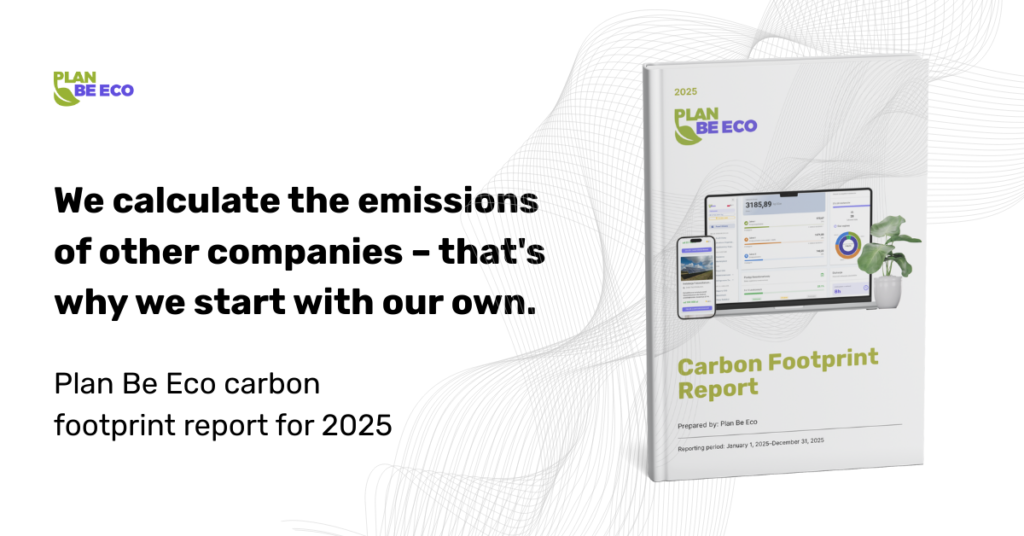
We calculate emissions for others – so we start with ourselves
At Plan Be Eco, we operate in the field of sustainable development based on recognized methodologies, in line with the GHG Protocol. We focus on ensuring that greenhouse gas emissions data is complete, comparable, and usable in decision-making processes, ESG reporting, and corporate sustainability disclosures, including non-financial reporting in accordance with the CSRD (Corporate Sustainability Reporting Directive).
Experience gained from calculating our own carbon footprint is an integral part of our approach. It allows us to better understand challenges related to:
data availability and quality,
carbon footprint calculation,
interpretation of results,
year-on-year communication of changes in the context of organizational growth.
Thanks to this, the support we provide to Plan Be Eco clients is based not only on methodological expertise, but also on hands-on experience in carbon footprint reporting, emissions management, and ESG data disclosure.
The Plan Be Eco 2025 report aims to support strategic emissions management and to build trust among clients and investors.
Analysis of Plan Be Eco’s carbon footprint
On a daily basis, we help companies calculate their organizational carbon footprint and product carbon footprint, report on ESG, and design realistic strategies for emissions reduction, energy efficiency improvement, and decarbonization.
We support companies and financial institutions in:
meeting regulatory requirements (CSRD),
ESG and non-financial reporting,
calculating emissions across the entire supply chain,
engaging suppliers and collecting data,
building climate and investment strategies.
That is why one thing is obvious to us: if we advise others, we must lead by example.
We regularly calculate the carbon footprint of our own operations and publish the results. We treat this as an element of:
Companies that regularly report their CO₂ emissions achieve, on average, a 67% higher return on investment than companies that do not report systematically. Climate data is increasingly used to support strategic and investment decisions, rather than serving solely as a reporting obligation.
What is a company’s carbon footprint?
An organizational carbon footprint is the total amount of greenhouse gas emissions, expressed as carbon dioxide equivalent (CO₂e), generated by a company’s activities—covering energy consumption, fuel use, raw materials, and operations across the entire life cycle of the business.
According to the GHG Protocol, emissions are divided into three scopes:
Scope 1 – Direct emissions
These include emissions from sources owned or controlled by the company, such as fuel combustion in buildings or company vehicle fleets. This is often the most intuitive, though not necessarily the largest, component of a carbon footprint.
Scope 2 – Indirect energy emissions
This scope covers emissions resulting from the purchase of electricity, heat, and cooling. Although indirect, decisions related to the energy mix have a real impact on their level.
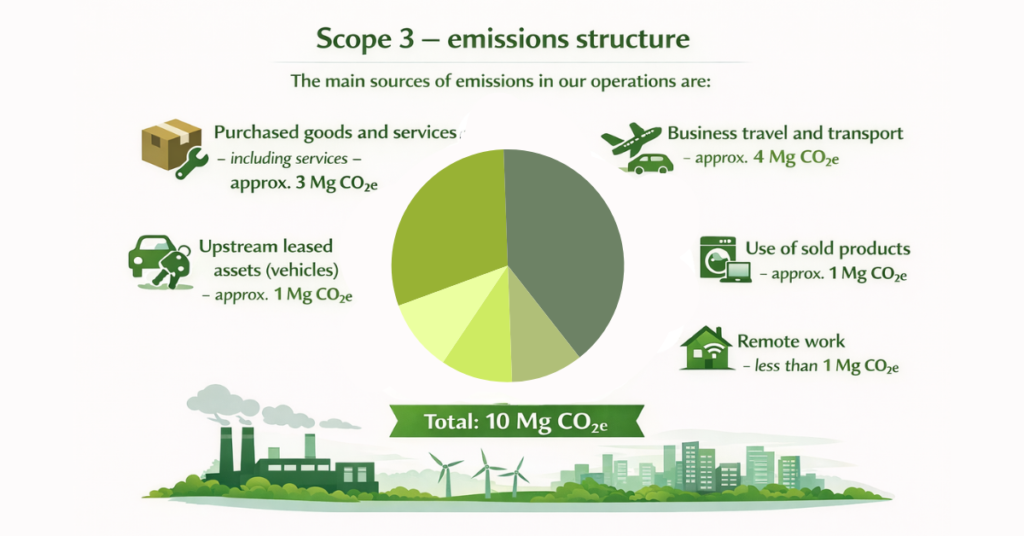
Managing and reporting Scope 3 emissions is more complex than Scopes 1 and 2, as it includes indirect emissions across the entire supply chain and often depends on data from suppliers and business partners. At the same time, it is the area with the greatest reduction potential. Scope 3 includes 16 categories, such as:
purchased goods and services,
transport and business travel,
use of sold products,
employee remote work,
supplier and contractor activities.
We calculate our clients’ emissions in exactly the same way—and we apply the same standards to our own data. CSRD-compliant reporting covers greenhouse gas emissions at all stages of a product’s life cycle—from raw material extraction, through production and transport, to use and end-of-life. This requires companies to go beyond their own operations and account for the entire value chain.
What is the total carbon footprint of Plan Be Eco?
In the analyzed year, the total carbon footprint of Plan Be Eco amounted to 10 Mg CO₂e.
Emissions structure by scope:
Scope 1: 0 Mg CO₂e
Scope 2: 0 Mg CO₂e
Scope 3: 10 Mg CO₂e
Total: 10 Mg CO₂e


![plan_be_eco_[Plan Be Eco carbon footprint report for 2025]_[eng]_emissions_co2_growth](https://planbe.eco/wp-content/uploads/2026/01/plan_be_eco_Raport-Sladu-Weglowego-Plan-Be-Eco-za-2025-rok_pl_emisje_wzrastaja_gry_firma_sie_rozwija-1.png)