Comprehensive Guide to 2026 Regulations: CSRD, CSDDD, SFDR, CBAM and the EU Taxonomy in Business Strategy

The year 2026 marks a new stage in EU regulations. It is the moment when CSRD, CSDDD, CBAM, SFDR, and the EU Taxonomy cease to be analyzed as a set of separate obligations and begin to operate as a coherent system directly influencing the business models of companies in the European Union.
Four legal acts – the Corporate Sustainability Reporting Directive, the Corporate Sustainability Due Diligence Directive, the Sustainable Finance Disclosure Regulation, and the EU Taxonomy Regulation – create a unified regulatory architecture covering corporate sustainability reporting, due diligence obligations across the entire value chain, and transparency of financial information on the capital market.
In practice, this means a permanent link between non-financial data and accounting, strategy, and access to financing. ESG becomes an element of corporate governance and management responsibility – not an add-on to the annual report, but an integral part of risk management and enterprise value creation.
Why is the European Union introducing new environmental regulations and what is their main objective?
The new obligations arise directly from the implementation of the European Green Deal strategy. Their main objectives are:
achieving climate neutrality,
mitigating the effects of climate change,
increasing transparency of non-financial data,
protecting human rights and labor rights,
redirecting capital toward activities aligned with environmental objectives.
The European Commission clearly states that financial stability in the European Union depends on companies’ resilience to climate and social risks. Therefore, the Directive of the European Parliament on corporate reporting and the Directive on corporate due diligence form part of a single regulatory architecture.
The regulations are primarily intended to protect the market against systemic risk.
What is the CSRD directive and what new obligations does it introduce?
The CSRD, concerning corporate sustainability reporting, fundamentally changes the way companies report.
What does the CSRD mean in practice?
extension of reporting obligations to large entities and listed companies,
introduction of uniform standards – European Sustainability Reporting Standards (ESRS),
mandatory audit of non-financial data,
digital tagging of the report.
Corporate sustainability reporting covers the impact of a company’s activities on the environment, society, and corporate governance, as well as the impact of these factors on financial performance.
The principle of double materiality requires analysis from two perspectives:
the impact of environmental, social, and governance factors on the company,
the company’s impact on those factors.
Who is subject to reporting obligations?
Scope: EU companies (>1,000 employees and >€450 million net turnover); non-EU companies (>€200 million net turnover through at least one subsidiary and >€450 million net turnover in the EU).
Application: From financial year 2024 (Wave 1); revised CSRD from financial year 2027 (EU) and 2028 (non-EU).
Member States are implementing the directive into national law – in Poland, this process requires amendments to the Accounting Act. The Ministry of Finance is responsible for drafting implementing regulations.
What role does the EU Taxonomy play and what are taxonomy disclosures?
The EU Taxonomy is a classification system defining which products and business activities can be considered environmentally sustainable.
It is based on six environmental objectives, initially focusing on the first two:
climate change mitigation,
climate change adaptation.
Technical screening criteria determine whether a given activity meets requirements in areas such as:
energy efficiency,
circular economy,
emission reduction,
reduction of plastic use,
protection of water resources and biodiversity.
Scope: Companies covered by CSRD; financial market participants; indirect impact on non-EU entities through CSRD/SFDR.
Application: From financial year 2022; Taxonomy revisions apply from financial year 2025 (with an option for deferral).
Taxonomy disclosures include the share of revenue, CAPEX, and OPEX aligned with the Taxonomy. Based on these disclosures, banks and funds assess the “greenness” of their portfolios.
The significance of the Taxonomy goes beyond reporting — without compliance with the technical criteria, the cost of capital increases.

What is CSDDD and the due diligence obligation about?
The Corporate Sustainability Due Diligence Directive requires companies to conduct due diligence across their entire value chain.
What does due diligence include?
identifying risks of human rights and labor rights violations,
assessing environmental impacts,
taking remedial actions,
monitoring the effectiveness of procedures.
Scope: EU companies (>5,000 employees and >€1.5 billion global net turnover); non-EU companies (if >€1.5 billion turnover is generated within the EU).
Application: The revised CSDDD applies from 26 July 2029.
Failure to implement it may result in sanctions, including financial penalties.
What is CBAM and the carbon payment obligation about?
The Carbon Border Adjustment Mechanism (CBAM) requires the equalization of carbon emission costs embedded in goods imported into the EU.
What is the scope of the CBAM levy?
Carbon reporting applies to importers of high-emission goods from outside the EU (including steel, cement, aluminum, fertilizers, electricity, hydrogen) and certain downstream products. It applies to all entities placing these goods on the EU market, regardless of the number of employees.
Application: As of 1 January 2026, the transitional period has ended — importers must make actual payments for certificates (full implementation phase).
How does SFDR connect companies with the financial market?
SFDR regulates disclosures by financial institutions regarding ESG risks and principal adverse impacts (PAI).
Data reported by companies under CSRD, as well as taxonomy disclosures, are used by banks and funds for:
assessing investment products,
classifying products as sustainable,
analyzing climate risks.
Scope: EU financial market participants (FMPs) and financial advisors; also applies to non-EU entities if financial products are marketed or managed within the EU.
Application: First full reporting cycle in financial year 2022; regulatory simplification is ongoing, with an expected agreement in 2026.
The Omnibus package and planned simplifications aim to improve data consistency and reduce excessive administrative burdens without weakening transparency.
How does data flow between regulations affect business strategy?
The regulations create a closed ecosystem:
Taxonomy → data for CSRD reporting,
CSRD → data for SFDR,
CSDDD → supply chain data for reporting,
CBAM → requires importers to have ultra-precise carbon footprint data (Scope 3),
due diligence results → updates to risk analysis.
As a result, corporate strategy must be designed holistically. Reporting and decarbonization plans are no longer add-ons — they become integral elements of business goal planning, risk management, and value creation for customers.
Do regulations increase costs or build competitive advantage?
In the short term, they mean:
increased investment in IT systems,
the need to hire specialists,
expansion of data analysis processes.
In the long term, they enable:
greater transparency,
stronger investor and customer trust,
reduced legal risks,
improved energy efficiency,
better control over supply chains.
Entrepreneurs who treat sustainability as a strategic element use regulations as a tool for building competitive advantage.
How does the Plan Be Eco Supplier support companies in keeping up with regulations?
Today, decarbonization and supply chain emissions management require not only reliable data, but also compliance with dynamically evolving regulations (CSRD, ESRS, CBAM).
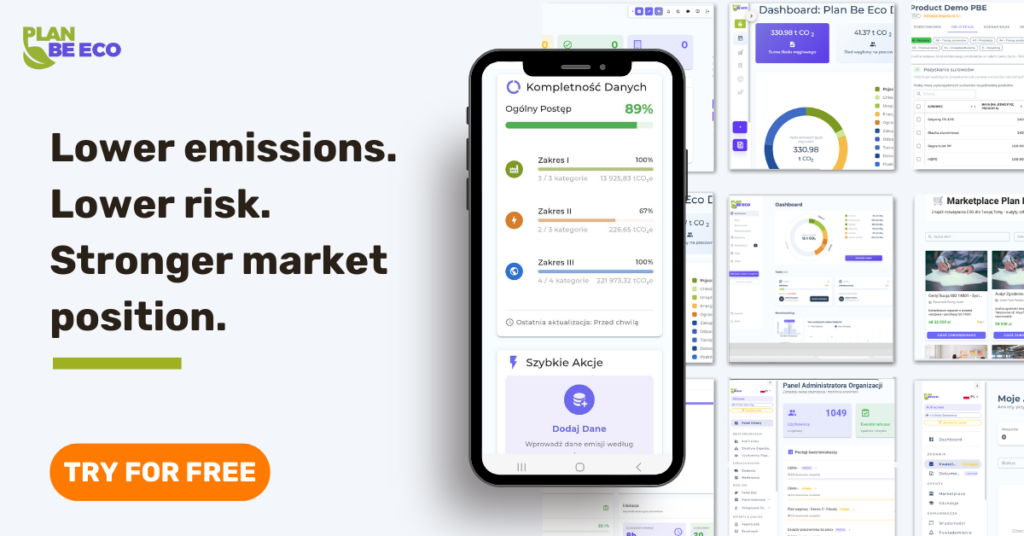
Plan Be Eco Supplier has been designed to organize data, monitor Scope 1–3 emissions, and support collaboration with suppliers within one coherent system — without the need to independently track and interpret complex regulatory requirements.
If you want to move from reactive reporting to conscious emissions and risk management, test the platform and see how it can support your organization in practice.
Summary
The Corporate Sustainability Reporting Directive (CSRD), the Corporate Sustainability Due Diligence Directive (CSDDD), the Sustainable Finance Disclosure Regulation (SFDR), and the EU Taxonomy now form a single, interconnected system. Non-financial data influences credit risk assessments, due diligence procedures determine a company’s position within supply chains, and taxonomy disclosures translate into access to financing. ESG has become an integral part of accounting, corporate governance, and risk management.
Companies that can:
-
integrate reporting with operational processes,
-
implement effective due diligence across the entire value chain,
-
organize data required by business partners and financial institutions,
-
link environmental and social actions with business objectives,
build a sustainable competitive advantage. Those that treat regulations solely as an administrative cost expose themselves to pressure from customers, banks, and investors.
FAQ
Do the new regulations apply to medium-sized enterprises?
Directly – only in specific cases. Indirectly – almost always, as suppliers to large companies subject to reporting and due diligence obligations.
What is the significance of the first CSRD-compliant reports?
The first reports set the standard for data quality and will form the basis for assessment by banks, investors, and supervisory authorities.
Does non-compliance lead to sanctions?
Yes. Possible consequences include financial penalties, administrative liability, and exclusion from supply chains.
Why is 2026 a breakthrough year?
Because the regulatory system in the European Union begins to operate as a coherent whole: sustainability reporting, due diligence, and financial disclosures can no longer be treated separately.
EU regulations in 2026 redefine the way business is conducted. This is not merely a reporting obligation — it represents a transformation of corporate management models in the field of sustainability, the integration of non-financial data with accounting, and a permanent link between environmental responsibility and financial performance.
Sources and Legal Basis
Corporate Sustainability Reporting Directive (CSRD) – Directive (EU) 2022/2464 of the European Parliament and of the Council
EUR-Lex: https://eur-lex.europa.eu/legal-content/PL/TXT/?uri=CELEX:32022L2464
Corporate Sustainability Due Diligence Directive (CSDDD) – Directive (EU) 2024/1760
EUR-Lex: https://eur-lex.europa.eu/legal-content/PL/TXT/?uri=CELEX:32024L1760
EU Taxonomy Regulation – Regulation (EU) 2020/852
EUR-Lex: https://eur-lex.europa.eu/legal-content/PL/TXT/?uri=CELEX:32020R0852
Sustainable Finance Disclosure Regulation (SFDR) – Regulation (EU) 2019/2088
EUR-Lex: https://eur-lex.europa.eu/legal-content/PL/TXT/?uri=CELEX:32019R2088
European Green Deal – European Commission strategy
https://commission.europa.eu/strategy-and-policy/priorities-2019-2024/european-green-deal_en
European Sustainability Reporting Standards (ESRS) – developed by EFRAG
https://www.efrag.org

